
Hi all! Thank you for the amazing response to the previous post. I have also received some suggestions for the next topic. So here is the next one.
Today, we shall be discussing about a common complaint we encounter in our clinics, and clarify certain myths and tackle few challenges related to this condition. We will be discussing about the swellings on the eyelid, which is initially painful and red and then may persist as a painless swelling for longer duration.
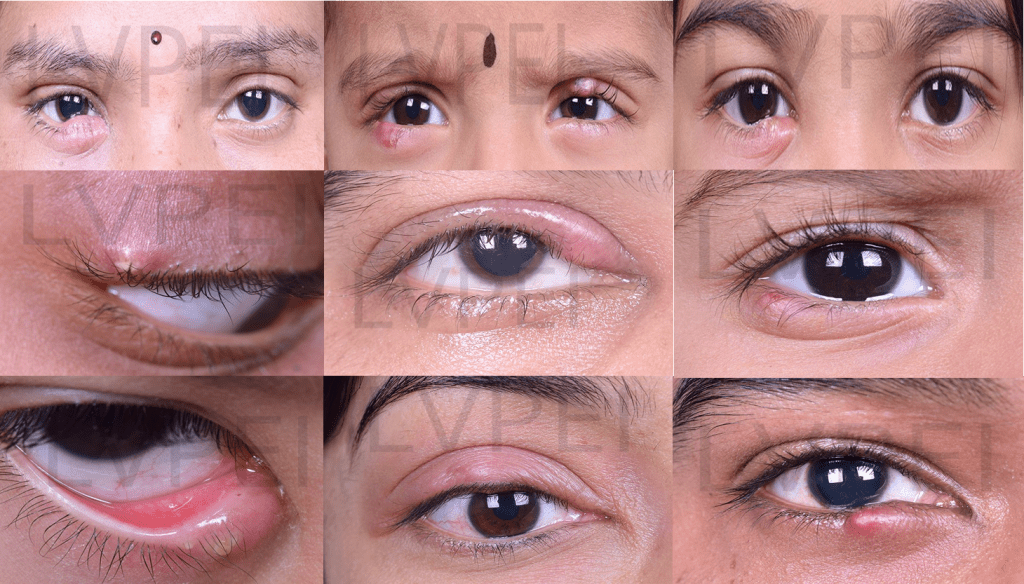
Look at the picture above. Sometimes there is a sudden emergence of pain on the eyelids with swelling and redness.
- What is this?
- This is an acute infection of the glands of the eyelid.
- The glands of the eyelid (internal or external) get blocked due to collected secretions which may get infected and result in the picture seen above.
- It is sometimes colloquially referred to as stye, in medical terms called as hordeolum.
- Why does this happen?
- We need to understand that there is no one particular reason for this happening. It has been related to poor lid hygiene like rubbing the eyes regularly, an underlying local condition like infection of the eyelashes (blepharitis), pimples, in-turning of the eyelashes, among others or due to systemic conditions like uncontrolled diabetes.
- There can be more causes like uncorrected refractive error (need to use glasses).
- How do we treat it?
- In acute phase like seen above where there is redness, pain and swelling, we need to start doing warm compresses first.
- At this stage, better to take an opinion of an eye doctor, as we need to start oral antibiotics and pain killers.
- Any associated condition mentioned above needs to be taken care of.
- Sometimes, it bursts on its own with pus discharge – indicates healing response and should be encouraged.
- How to do warm compresses?
- There are many ways to do warm compresses.
- Eye mask available online – needs to be heated in the microwave for 20 sec and then wear it like a mask over the eyes. (Check AMAZON)
- Easier home remedies – take a clean cotton handkerchief, iron it, make it warm and place it on the closed eyelids.
- Alternatively – soak the handkerchief in lukewarm water, squeeze it completely and then apply it on the closed eyelids.
- Another solution for office goers (practical, but may be less effective) – When drinking coffee/tea, wrap the handkerchief around the cup. Once warm, apply it to closed eyelids.
- Why warm compresses?
- The meibum (secretion within the glands) melts at about 39 – 41 degrees centigrade and therefore temperatures above 41 degrees will help melt the sebum in the eyelid glands and thus help in establishing effective drainage.
- Should I use an antibiotic eye ointment?
- Yes, eye ointment can be used at night. Using it in the morning can cause blurring of vision and may affect your work.
- Ointment is long acting and is gradually absorbed through the tissues and thus can be of help in curbing the infection.
MYTH:
- Should we use eyedrops?
This is an infection affecting few of the glands in the eyelid. Any eyedrop you instil is going to act on the surface and not penetrate inside the eye. It does not stay long enough on the surface to penetrate the tissues required. So an eyedrop will not be useful in this condition.
CHALLENGE:
- Sometimes this acute infection may turn into a chronic one (called as chalazion medically), where the pain and the redness subsides and what remains is a painless swelling on the eyelid. (refer picture below)
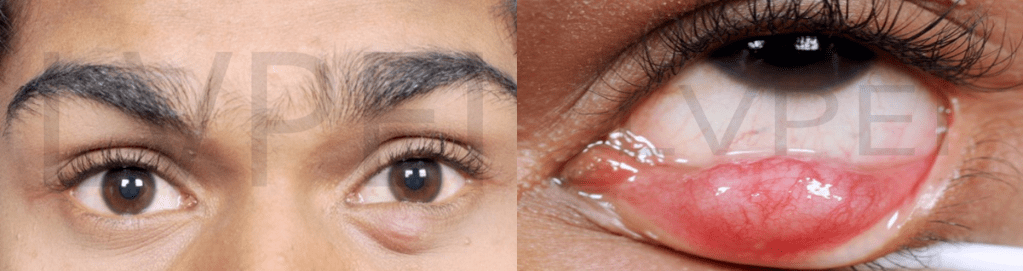
- Once it becomes chronic, we have two options – to treat it conservatively or surgically.
- Conservative treatment:
- Only and only ‘WARM COMPRESSES’. The question arises here is how long to continue these compresses. This is a slow process and may take anywhere from 6 weeks to 2 months or longer. KEY is to do it regularly.
- How often do we do warm compresses? – Atleast twice daily, 10 mins each sitting
- Any medications to be used ? – At this stage there is no acute infection. No medication is needed at this stage to treat the infection.
- NO EYEDROPS, NO EYE OINTMENT, NO MEDICATIONS, ONLY WARM COMPRESSES
- Surgical/ minimally invasive treatment:
- Please visit your eye doctor to know about the various minimally invasive/ surgical options for treating this conditions.
NOTE: Sometimes these swellings may mimic a serious condition of the eyelid – therefore any doubts or concerns, please consult your eye doctor. Also, you can freely write to me for any further clarifications if needed.
I hope this was helpful. I will come up with more frequently encountered questions in the clinic with logical and scientific explanation for the same.
Dr Nandini Bothra
Consultant, Govindram Seksaria Institute of Dacryology,
Ophthalmic Plastic Surgery Services,
L V Prasad Eye Institute, Hyderabad.
Email id: nan_bothra@yahoo.com
 EyePlasty
Awesome
LikeLiked by 1 person
Nice 👍🏻
LikeLiked by 1 person
Nicely written 👍🏻
But I have a doubt
Does the stye turn into chalazion if not treated ? Or are these 2 different ..
One is external and the other one is internal hordeolum?
LikeLiked by 1 person
Hi Ayushi. Yes there is external hordeolum which is otherwise called stye. This is usually at the edge of the eyelid near the hair follicle. You will usually see a pus point and if you pull the lash, there may be pus drainage. This usually heals after drainage.
The internal hordeolum is a little away from the margin (mostly, except the marginal variety) – may/may not drain spontaneously. This when persists can lead to chalazion formation.
I hope this clears your doubt.
LikeLike
Amazing
LikeLiked by 1 person
Very informative. Thank you!
LikeLiked by 1 person
Namaskaram mam
It’s a wonderful explanation about stye/chalzion.
What to do if there is recurrence despite having gone for surgery twice/ thrice. How to proceed in that case.
LikeLiked by 1 person
Hi Vivek…
So there can be many reasons for recurrence.
1. Look at the exact place of recurrence. It may not be recurrence but a new hordeolum. You need to understand there are 40+ gland in the upper eyelid and 20+ in the lower. So we treat that one gland which is involved and now the gland next to it is affected.
2. Wrong technique – the technique used may be faulty
3. It may have formed a cyst with walls around it, then it will involve removal of the cyst with its wall. If not done, recurrences will happen.
4. Depending on age – malignancy is a possibility – though a small chance but will need to be kept in mind.
If you need further details – pls send me photographs on my mail and we can go thru them and reach a conclusion.
Thanks again. I hope this was helpful.
LikeLike
Very nicely explained.
LikeLike